
A lower mortgage payment during your first year of homeownership can sound appealing, especially when you’re also managing moving expenses, furniture purchases, and the responsibilities of owning a home.
One financing strategy that may help eligible buyers manage their initial payments is a 2-1 buydown mortgage.
But how does a 2-1 buydown actually work? Who pays for it? And what happens when the temporary payment reduction ends?
Understanding these details can help you decide whether a temporary mortgage buydown is worth considering.
What Is a 2-1 Buydown Mortgage?
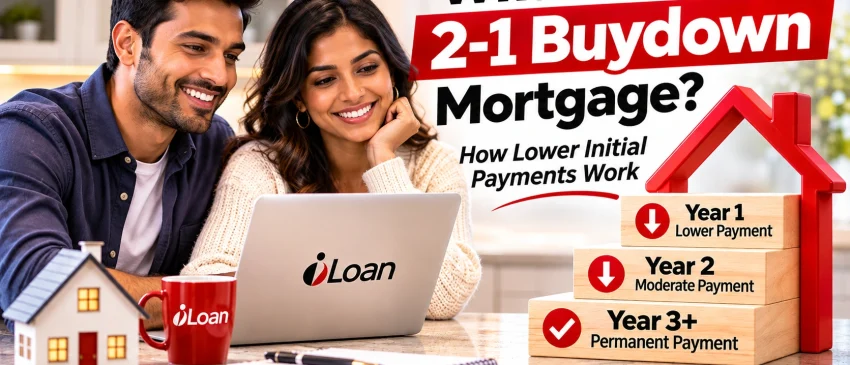
A 2-1 buydown is a temporary mortgage payment arrangement that reduces the borrower’s required principal-and-interest payments during the first two years of an eligible mortgage.
The mortgage has a permanent contractual interest rate, commonly called the note rate. In a typical fixed-rate 2-1 buydown, that contractual rate does not change during the temporary buydown period.
Instead, funds deposited for the temporary buydown subsidize part of the borrower’s scheduled mortgage payment.
The payment structure generally works as follows:
- Year 1: The borrower makes a principal-and-interest payment equivalent to a rate two percentage points below the permanent note rate.
- Year 2: The borrower makes a payment equivalent to a rate one percentage point below the permanent note rate.
- Year 3 and beyond: The borrower makes the full scheduled payment based on the permanent note rate.
The temporary payment reduction is funded in advance under the applicable buydown agreement.
How Does a 2-1 Buydown Work? A Simple Example
Consider a hypothetical 30-year fixed-rate mortgage with a permanent note rate of 6.50%.
With a traditional 2-1 temporary buydown, the payment-equivalent rates would follow this schedule:
| Payment Period | Payment-Equivalent Rate |
|---|---|
| Year 1 | 4.50% |
| Year 2 | 5.50% |
| Year 3 and Beyond | 6.50% |
Important: These are hypothetical payment-equivalent rates, not current iLoan mortgage rates or annual percentage rates (APRs). The permanent contractual note rate remains 6.50% in this example. An actual APR depends on loan-specific terms and applicable finance charges. This example is for educational purposes only.
For a more personalized illustration, visit the iLoan 2-1 Buydown Mortgage Calculator and enter your own hypothetical loan details.
Who Pays for a 2-1 Mortgage Buydown?
A temporary mortgage buydown requires upfront funds to cover the difference between the full scheduled mortgage payment and the borrower’s reduced payments during the subsidy period.
Depending on the loan program and participating lender, eligible funding sources may include:
Seller-Paid Buydowns
A seller may agree to contribute toward an eligible temporary buydown as part of the purchase negotiations.
For example, a buyer may negotiate a permitted seller concession to fund a 2-1 buydown instead of using the same concession toward other eligible closing costs.
Seller contributions are subject to applicable loan program limits and lender requirements.
Builder-Paid Buydowns
Some homebuilders offer temporary mortgage buydown incentives on eligible new construction purchases.
These incentives may help buyers manage their initial mortgage payments while purchasing a newly constructed home.
Actual availability depends on the builder, mortgage program, and lender.
Other Permitted Funding Sources
Other funding arrangements may be permitted under certain mortgage programs.
Not every source of funds is acceptable, and contribution restrictions vary. A mortgage professional should confirm the applicable requirements before a buyer relies on a proposed buydown arrangement.
What Are the Potential Benefits of a 2-1 Buydown?
A temporary buydown may offer several potential advantages for eligible homebuyers.
Lower Initial Mortgage Payments
The most direct benefit is a lower required principal-and-interest payment during the first two years.
This may provide additional monthly cash flow while the buyer adjusts to homeownership expenses.
Additional Purchase Negotiating Options
In some transactions, a seller-paid buydown can provide an alternative use for permitted seller concessions.
Buyers should compare this strategy with other options, including eligible closing cost assistance or a lower purchase price.
Predictable Permanent Note Rate
With a fixed-rate mortgage, the contractual note rate remains fixed according to the loan agreement.
The scheduled increase in the borrower’s required payment results from the temporary subsidy decreasing and ending, not from an adjustable interest rate.
What Happens When the 2-1 Buydown Ends?
Beginning in month 25, the temporary subsidy generally ends, and the borrower becomes responsible for the full scheduled principal-and-interest payment.
This is one of the most important considerations when evaluating a 2-1 buydown.
Although the initial payments may be lower, buyers should make sure the full permanent payment fits their long-term budget.
Property taxes, homeowners insurance, mortgage insurance, and other applicable expenses may also affect the total monthly housing payment.
A 2-1 buydown should not be selected based solely on the first-year payment.
Do You Qualify Using the Lower First-Year Payment?
Generally, borrowers must qualify using the applicable permanent mortgage payment rather than the temporarily subsidized payment.
Lenders evaluate factors such as:
- Credit history and applicable credit score requirements
- Documented income and employment
- Debt-to-income ratio
- Down payment and available assets
- Property eligibility
- Applicable loan program and underwriting requirements
A temporary buydown does not replace the normal mortgage approval process.
Can You Refinance a Mortgage With a 2-1 Buydown?
Refinancing may be possible if the homeowner qualifies for a new mortgage and meets applicable lender requirements.
However, future mortgage interest rates cannot be predicted, and refinancing is never guaranteed.
The treatment of any unused temporary buydown funds depends on the applicable agreement and loan program requirements.
Homebuyers should be financially prepared for the full scheduled payment even if they hope to refinance in the future.
Explore additional options on our Mortgage Refinance page.
Is a 2-1 Buydown Better Than a Permanent Rate Buydown?
Neither option is automatically better for every borrower.
A temporary 2-1 buydown reduces required payments for a limited period, while a permanent rate buydown may reduce the contractual interest rate through eligible discount points.
The best choice depends on several factors, including:
- The upfront cost of each option
- The amount of available seller or builder contributions
- The expected length of time in the home
- The borrower’s long-term payment budget
- The permanent mortgage rate and total financing costs
Buyers should compare the full financial impact of each option rather than focusing only on the first year’s payment.
Which Mortgage Programs May Allow a 2-1 Buydown?
Temporary buydowns may be available with certain eligible fixed-rate purchase mortgage programs, depending on participating lender requirements.
Potential options may include:
Not every lender or loan product offers temporary buydowns. Eligibility and permitted funding arrangements must be confirmed for the specific mortgage.
Explore 2-1 Buydown Mortgage Options With iLoan
A 2-1 mortgage buydown may help eligible buyers manage temporarily reduced payments during their first two years of homeownership.
However, it’s important to understand the permanent note rate, full payment obligations, upfront funding requirements, and available financing alternatives.
iLoan helps borrowers explore mortgage options in Illinois, Indiana, Iowa, Wisconsin, Minnesota, and Florida.
Visit our 2-1 Buydown Mortgage Program page to explore how temporary buydowns work and use our interactive calculator.
Explore Your Mortgage Options and Get Pre-Approved With iLoan →
Important mortgage disclosure: This article is for general educational purposes and is not a loan offer, rate quotation, Loan Estimate, or commitment to lend. The temporary buydown payment-equivalent rates described above are not contractual note rates or APRs. Actual interest rates, APRs, loan terms, fees, program availability, permitted funding sources, and qualification requirements vary. All mortgage loans are subject to applicable underwriting and approval requirements.


No Comments
Be the first to start a conversation